Monday, February 2, 2015

Tree-Man Syndrome


This is Dede Koswara, and, sadly, this photograph is entirely real.  It is not some set of make-up effects from a Stan Winston School dropout.  It's the result of an extremely rare genetic disorder known as Epidermodysplasia verruciformis, a.k.a. Tree-Man Syndrome.

Individuals with this disorder are extremely susceptible to Human Papillomaviruses (HPV) on the skin.  Once HPV infects the person, their bodies are incapable of fending off the virus, and it multiplies out of control.  This produces layers of scaly macules (changes in color), and papules (fluidless bumps), usually concentrated around the hands, feet, face, and genitals.  More benign cases only suffer from flat, wart-like lesions over the body.  More malignant cases, like that of Dede Koswara, produce carcinomas and polymorphic legions.

In essence, individuals with this disorder cut or scrape themselves (usually during adolescence), breaking the skin.  At that point, they are infected by HPV, and soon their skin begins to grow into hard, scaly, rootlike structures.  It overwhelms their fingers and features, making it difficult or impossible to eat and continue everyday life.

Treatments include surgeries to remove the growths, but this is a temporary coping mechanism rather than a cure.  Various drugs and supplements are currently being tested with mixed results.

Photographs of Dede Koswara first appeared on the internet in late 2007.  As one of the most severe cases of Tree-Man Syndrome to date, he was quickly picked up by a number of American tv shows on the Discovery Channel, TLC, and ABC.  They chronicled the story of how his life fell apart once his growths became overwhelming.

When he was 10 years old, Dede was playing in the forest near his home in Java and cut his knee.  Soon warts began appearing around the cut.  They spread.  It took years, but the growths eventually crept over Koswara's body.  Though they didn't hurt or itch, they smelled terrible.  He got married and had two children.  But by the time he was 28, the growths had completely covered his hands, rendering them totally useless.  He was no longer able to do his job as a construction worker.  His wife left him.  Without the ability to work, Koswara joined a travelling freakshow to support his kids.
It was during this time that pictures of him surfaced, attracting the attention of documentary-makers.
During 2008, Dede received experimental surgery to remove some of the growths from his extremities.  It was successful, and allowed him the use of his hands for the first time in 10 years (he was 34 at the time).  At the same time, doctors gave him chemotherapy to bring the HPV under control.  Unfortunately, the treatment was cut short when his liver began to fail.

In a turn of international drama, before the treatment could be completed by an American dermatologist named Gaspari, the Javanese government became involved.  They kicked Gaspari out of Java on suspicion of taking blood and tissue samples abroad for commercial purposes.


Since the treatment, Koswara's warts have begun to grow back.  He's had to return to his parents house where they clean him and feed him; dress him in his specially zippered shirts.

I'll leave you with a quote from Koswara himself:

"They say I'm not human.  Whatever they want to say, that's fine.  I guess I am a Tree-Man...  My body has again betrayed me, but what can I do?"

-Joanna

Saturday, January 31, 2015

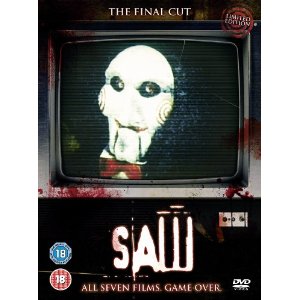
The Saw Series - Movie Review

My apologies for this post appearing a day late.  Hope you enjoy this on a Scary Saturday instead of a Film-Review Friday.


The Saw Series
Released 2004-2010
Directed by James Wan (Saw), Darren Lynn Bousman (Saw 2-4), David Hackl (Saw 5), Kevin Greutert (Saw 6, Saw-3D).
Written by Leigh Whannell (Saw - Saw 3), Patrick Melton and Marcus Dunstan (Saw 4- Saw-3D)
CONTAINS SPOILERS.  All the spoilers.


Do you want to play a game?  These are the rules: I watched all seven Saw movies.  You're going to give me money, or possibly a cupcake, and I'll tell you about them.  I get a cupcake, and you don't have to watch ALL SEVEN SAW MOVIES.  It's a win-win.

Seriously, though, the horror genre is the true breeding ground of long-running series.  Even before the greats from the 80's (Freddie, Jason, Mike Meyers), we had Christopher Lee's Dracula and Dr. Mabuse popping up again and again in movies of varying continuity.

The issue is that many of these movies are made for money, and not necessarily out of... shall we say, artistic vision.  Jason X works better as a gory comedy than as nightmare-fuel.  Thus, they're pretty far down on the watch-list.

Up until this point, I've gotten by on watching the first, or possibly second, entry in these massive series.  It works enough to be passingly literate.  But, now's the time to bite the bullet and get actually literate.  I've decided to watch through these massive series.  Yup, every single last one.  One of these days I'll get to Hallowen H2O, and you'll be able to hear my screams two counties over.  But for now, I'm just going to write a lengthy, textbook-type article encapsulating my thoughts of the series as a whole, with short vignettes for each feature.

Introduction

What is Contrapasso?


The Saw series follows the late career of John Kramer, a.k.a. Jigsaw, a former industrial engineer who kidnaps people and traps them in ironic torture scenarios.  These experiences are supposed to make them reconsider their priorities and treasure life.  This turns out to be an unfortunate goal because most of them die horribly before they get the chance to make good on their revelations.  The series is characterized by graphic, gizmo-powered death scenes and twist endings intended to recapture the magic of the first film.

While the Saw series may have taken the gruesomeness of its death scenes to the next level, at its heart, it's in the business of telling a very old tale.  What you do will come back to haunt you.  Your sins will be punished accordingly.  Justice will be served, and it won't be pretty.

For centuries, audiences have been captivated by tales of ironic punishment. Possibly the most well-known is that journey to the very bowels of hell: Dante's Inferno.  In the second circle of Hell, those guilty of Lust are whipped about in a ceaseless, hail-laced whirlwind, representative of how these "carnal malefactors" were blown about aimlessly by their appetites.  In the seventh circle of Hell, those who were violent toward others are immersed in a lake of boiling blood.  In the eighth circle, there's a section devoted to sorcerers, astrologers, and false prophets, wherein their heads are twisted backwards on their body.  These souls are now doomed for all eternity to look backward and stumble forward blindly, in perfect punishment for their attempts at future-telling.

Looking for a catchy word to sum up this rather heavy-handed device?  Well, we've already got one!  Contrapasso, from the Latin contra and patior, meaning to "suffer the opposite", describes punishment via a process that closely resembles, or is directly opposite to the sin itself.  Dante seems to have taken this to heart, as contrapasso is clearly a guiding principal in his imaginings of Hell.  For example, in one of the Bolgia of the eighth circle, Dante meets Bertran de Born, who has now been decapitated- a contrapasso for his involvement in the rebellion against King Henry II of England. He attempted to undermine the 'head of state', so guess what happened to his own head....

Them's the breaks.

Now, all this talk of sins has probably got you thinking about one of the best contrapasso-based movies of all time: Se7en.  A film where Gluttony is forced to eat himself to death and Vanity has her face mutilated would certainly make Dante proud.  I'm not going to review Se7en here, but do want to mention it as a star in this thematic constellation.  Not just because it brought contrapasso roaring back into the American' consciousness, but because the Saw series is heavily influenced by Se7en, even unto details like scene framing and cinematography techniques.

Contrapasso, however, is not always as elegant as it is in Se7en.  How do you punish someone who, say, poisons neighborhood dogs?  I would safely say poisoning dogs for fun is pretty evil, but how does one make a device (figurative or, as Jigsaw likes it, literal) to punish such a person?  Have a dog poison them?  How would that even work?  I suppose you could have him torn apart by drugged up dogs, but that doesn't seem to fit.  The best I can think of is a device that measures the saliva a dog produces, and inserts an equal quantity of poison into the person's veins.  As you can see, sometimes contrapasso has to get pretty unfocused and weird to work for every scenario.  Sadly, this diffusion plagues the later Saw movies.

Part 1

Saw - the creation of a monster


In 2004 an indie horror flick hit theaters just in time for Halloween.  Met with mixed reviews from critics, it soon gained a cult following, eventually grossing over $100 million worldwide.  By the end of the opening weekend, a sequel had been greenlit, and Saw was on its way to becoming a Halloween staple for the next six years.

With a budget of $1 million, this debut by director James Wan and writer Leigh Whannell, is at heart more a mystery-thriller than torture-porn.

It begins with two men chained to opposite corners of a huge, crumbling bathroom.  In the center of the floor is a dead body, an apparent suicide.  As they investigate the room around them, they discover micro-cassette tapes that instruct them on their individual missions.  Adam, a photographer, must use the hacksaw to cut off his foot and escape.  Dr. Gordon, an oncologist, must kill Adam by 6 o'clock, or he, his wife and child will all be killed.  At this point, Dr. Gordon announces that they've been captured by the Jigsaw killer.

Turns out the Jigsaw killer has a habit of kidnapping people and placing them in contrapasso traps, each with a possible escape. Only one person made it out: Amanda Young.  Detectives on the trail of the Jigsaw killer accosted Dr. Gordon, one in particular (Tapp) believing Dr. Gordon to be the killer himself.

As the movie unfolds, Adam and Gordon recount the moments before their kidnapping, and we follow the detectives as they track Jigsaw.  Gordon's family is held hostage, and as the plot-lines mingle and converge, it rises to a climax of Dr. Gordon making good on that saw.  With minutes left, he hacks off his foot, and shoots Adam, then struggles to the door to make his escape and save his family.  A few moments afterward, the hostage-taker arrives to kill Gordon, but is attacked and killed by Adam (with the toilet tank cover, in the dirty bathroom).

Upon searching the body, Adam discovers another tape, which shows the hostage-taker to only be a pawn in the game.  This is when the body in the middle of the room gets up, and John Kramer, the real Jigsaw, is revealed.  He walks out of the bathroom, slamming the door behind him, dooming Adam to death.  Fin.

Say what?!

Jigsaw is a blunt but apropos thing to name a killer in a movie so twisty-turny.  It's a cliche that a movie "keeps the audience guessing", but I think Saw actually accomplished this in its day.  It's clear that a part of Saw's success was the twist-ending and accompanying montage.  Unlike the Sixth Sense whose twist montage consisted of "See!  Proof!" segments, the montage in Saw feels like snapping down that last piece in a puzzle, and the full image finally clicking into focus.  Two things make this work.  First, Saw kept enough secrets and its pace so rapid, that the audience didn't have time to linger on theories.  Secondly, the movie has enough characters and story strings that it's difficult to even begin formulating coherent theories when you're simply trying to keep up with events.  It's this controlled release of information that makes the ending surprising and not janky.  Sadly, this buck stopped here, and despite the best efforts of six more movies, none of them had an ending that didn't seem pathetically contrived.

Another sad thing is how dated Saw appears.  The grimy green aesthetic makes it look like they snuck onto a CSI set for any scene shot outside the bathroom.  The torture scenes, in particular, suffer from the super-sped-up thrashing technique.  I remember the first time I saw this technique in Jacob's Ladder and it Freaked Me Out.  But since then, it's been used as a short-cut to terror so frequently that it's lost its kinetic energy.  Sorta the same way that ghosts who tilt their head to the right aren't as scary anymore.

The other major flaw of Saw is its ham-handed script.  Not the story, not the acting.  But purely the script: the words that have to come out of the actors mouths.  Now, I don't mean to rake Whannell over the coals for the cracks in his debut, however, I think this is a point worth making clear.  A lot of people panned Saw because of 'bad-acting'.  I don't think this is fair.  Honestly, I felt like the actors were doing the best with what they had to say.  There's only so much you can do with dialogue that belongs in a mid-century short story magazine.  Laughably mechanical transitions, melodrama, and TELLING THE AUDIENCE THE OBVIOUS THING JUST TO MAKE IT CLEAR, are all faults that can be fixed with experience.  So, just when you're laughing at how dumb Cary Elwes' Dr. Gordon seems, just remember, he's doing the best he can.

However, despite these flaws in aesthetic and wording, I thought that Saw actually stands up well as a really entertaining movie.  It's got all the yummy tropes that I love seeing in horror/thrillers.  Danny Glover's Tapp character goes crazy, so of course he makes The Crazy Wall full of notes and photos lined with string.  Characters are kidnapped by the shadowy, cloaked figure with a pig-face.  Of course, the piece de resistance is how Jigsaw uses a creepy ventriloquist dummy on a tricycle to recite instructions to his victims.  It took me right back to second grade, reading Goosebumps.

So doll. Much spoopy.

Part 2

Saw II through Saw 3D:  All those other ones


This is the part where my academic aspirations fall apart.  Honestly, only Saw II and Saw III are even worth watching, and they're painful at that.  All of the others should just... never be watched.  I don't care what the score for Saw VI is on Rotten Tomatoes, it's bad.  So, I'm just going to snarkily summarize everything you need to know about all these other Saw movies.

It is disappointing how these all split into two sections where the original film blended them nicely.  The sections being: people being tortured, and what's going on with Jigsaw's personal life.  In the original Saw, the people being tortured were intimately intertwined with Jigsaw.  Dr. Gordon was his oncologist who delivered the news that Kramer only had a short time to live.  This diagnosis, in turn, was the impetus for Kramer to start his second career as Jigsaw.  Adam was a photographer who helped Jigsaw stalk his victims.  The brief section of torture scenes were included to set the stage for what kind of madman Jigsaw is.  In all the other movies, though, there's a gulf  between torture victims and Jigsaw, The Man Himself.  Since this is how the Saw franchise is inflicted on its audience, so too shall I inflict my summaries upon you.

Saw II - the one in a house


Waaaah.  Why did I put both hands in?

In people getting tortured news:  A bunch of ex-cons are locked in a house.  Amanda, the survivor, is among them.  They've all been injected with a poison that will kill them if they don't take an antidote.  Syringes of the antidote are sprinkled throughout the house in various torturous puzzles.  The convicts murder each other, kill themselves, or accidentally get shot in the face until it's down to Xavier the brute, Amanda the survivor, and Daniel the plot-device.

In Jigsaw's personal life: His secret lair has been found by a real asshole of a detective named Matthews (played by Donnie Wahlberg).  Jigsaw's lair is outfitted with an array of closed-circuit tvs, all showing what goes on in the ex-con house.  Matthews sees his son, Daniel, and proceeds to interrogate Jigsaw in an attempt to locate the house and save his plot-device.  By the end of the movie, Daniel is threatened by Xavier, and Matthews forces Jigsaw to take him to where the torture-drama is playing out.

Twists:  Amanda was working with Jigsaw ALL ALONG.  The footage on the cctvs had been taped days before.  Daniel was sitting in a safe in Jigsaw's lair, ALL ALONG.  When Matthews gets to the house he's attacked by Amanda wearing the pig-cultist garb and thrown in the bathroom where Adam died in Saw.

Summation:  Speed as directed by Foucault.

Saw III - the one with the doctor


Hippocratic oath, my ass...

In tortured-people news:  A man named Jeff whose son was recently killed in a hit and run accident is put through a series of tests to get him to let go of his vengeful feelings.  He comes face to face with the people tangentially involved in the death of his son, and has to make the choice for them to live or die.  Some of them he saves, some he lets die via contraption.  By the end, he's made it to the heart of Jigsaw's second lair.

In Jigsaw news:  Jigsaw is dying.  Dr. Denlon has been kidnapped to care for him.  Of course, she needs some incentivization, so Amanda wraps a collar around her neck which is connected to Jigsaw's heart monitor.  If Jigsaw dies, or Dr. Denlon moves out of range, it will explode her head.  Unfortunately, Dr. Denlon doesn't want to participate, and even when she does, Jigsaw's lair is woefully under-supplied (and Amanda is quite the inept nurse).

Twists:  The tortured man is actually Dr. Denlon's husband!!!  Amanda gets very upset and shoots Dr. Denlon, just in time for Jeff to shoot Amanda in return.  Jeff says he forgives Jigsaw and summarily bone-saws through his throat.  Dr. Denlon's collar goes off, the doors lock, and Jeff is trapped in a room with 3 corpses.

Summation:  More frustrating, pointless, and confusing than my Heidegger seminar.

Saw IV - the one with a black detective


Sweet jacket, poor interior decorating.
In torture headlines: Riggs, a detective featured briefly in previous movies, is led on a goosechase to teach him the true meaning of "saving a life".  Riggs is put in room after room with "foul, irredeemable" criminals, and compelled to do nothing, letting their own contrapassos play out.  This is a heavy-handed attempt at evangelism by Jigsaw, trying to get Riggs to see that the Saw method of rehabilitation is truly the only way to save a life.  Bummer that a bunch of these people die anyways.

In Jigsaw news:  Jill, Jigsaw's ex-wife, is brought in for questioning.  During the interview, she reveals the long, tear-jerking backstory of John Kramer.  Years ago, John was a civil engineer heavily involved in property development (makes sense of why he knows about ALL the abandoned buildings), and Jill had been pregnant, working at a clinic for drug addicts.  One night the clinic is robbed by an addict, who in the process bashed a door handle against Jill's pregnant stomach, causing a miscarriage.  That addict turned out to be Jigsaw's first victim.

Twists:  This whole movie takes place AT THE SAME TIME as Saw III.  Riggs bursts into the room with Jeff and the 3 corpses.  I flipped the table and officially cast a pox upon this franchise.  

Summation: Libertarianism 101 as written by people who hate Libertarians and spend too much time on Facebook.

Saw V - the one with a new Amanda


It's my head in a box!
In tortured souls:  Five people who are known for their ruthlessness awake in a room with collars around their necks.  They're implored to do the opposite of their instincts and work together instead of looking out for numero uno.  Each room is on a timer, and when the timer expires, a nail-based IED will kill anyone left within.  One by one, the people are killed, as it is slowly revealed they were all involved in a dirty real estate deal.  They burned down a building full of squatters to make room for a fancy new development.  By the last room, there are only two people left, and they realize all of the traps could have been escaped with a healthy dose of teamwork.  Wah- wamp.

Meanwhile, back at the Jigsaw:  A detective with a natural pout named Hoffman rescues the daughter of the Denlons.  He's hailed as a hero, until one other, other survivor is found: Strahm, the guy with his head in a box.  Strahm is suspicious of Hoffman, and with good reason.  Turns out Hoffman has somehow also been Jigsaw's apprentice ALL ALONG?  In one of the most epic semi-ret-cons and undercuttings in film history, Amanda is thrown under the bus and characterized as a mere nursemaid and floundering secretary while Hoffman gets all kinds of pouty, black glove, Man-work done.  Strahm digs around and finds out that Hoffman is the new Amanda.  Strahm is then tricked into a trash-compactor where he chooses not to lie down in a coffin full of glass.  Hoffman duck-faces as the glass coffin lowers him to safety.

And you thought I was joking.  Quack.
Twists:  Shoulda laid in that glass coffin, yo.

Summation:  What did any of this have to do with anything?  Who are all these people?  I need to make a Crazy Wall.

Saw VI - the one about healthcare


I don't need insurance, I'm only sixteeeeeeeeen!
Once there was a point to this:  A health insurance executive is put through the old Jigsaw sausage-machine.  He has to make choices about peoples' lives, and it's super boring because it's hard to believe he has any concern for these people AT ALL.   There's one scene where his pool of cracker-jack proteges are tied to a merry-go-round (I shit you not), and he has to push a button to give two of them a pass.  I.e. let them not be shot in the chest with a shotgun.  The foley artist had a lot of fun with bacon sound-effects.  There's also some device with acid.

No, really, I swear there was a point this:  More people investigate Hoffman.  Jill, Jigsaw's ex, gives him five envelopes of people Jigsaw wanted Hoffman to kill.  It is revealed through a flashback that the health insurance guy denied Jigsaw coverage for an experimental Norwegian cancer treatment.  At the end, Jill puts a reverse bear-trap device on Hoffman's head but he escapes it because he's sooooo much cooler than Amanda, you guys.  No seriously, we need you to love him.  Our self-esteem depends on it.

Twists:  Jill is apparently the new-new-Amanda.  You spent 90 minutes watching this thing.

Summation: Seriously, nobody cares about Hoffman.  Where is Amanda?  I miss her.

Saw 3D - the one where Cary Elwes comes back


In a three-piece suit, no less.

Torture IN 3D!:  A self-help guru who claims to have escaped a Jigsaw device is on a book tour.  Unfortunately, he's a bit of a liar.  After going to a support group for Jigsaw survivors [Sidenote: I have to respect this because it really lampshades how many Saw movies there are, and how high the body-count is.], the guru is kidnapped and put through a series of tests.  He has to save the team of publicists, lawyers, et. al. that helped him get famous on his pretense that makes a mockery of Jigsaw's life's work (snort).  At the end, he has to save his wife.

Jigsaw IN 3D!: Jill turns herself in to the police for protection from Hoffman.  Hoffman kills a bunch of people to get to her and eventually does.  He kills HER via reverse bear trap this time, then sets his lair on fire, considering his work to be complete.  As he leaves, three goons wearing pig-cultist garb attack him and leave him for dead in the original bathroom.

Twists:  One of the goons is Dr. Gordon!  HE WAS WORKING WITH JIGSAW ALL ALONG!!!!  He's the new-new-new-Amanda.

Summation:  Where is all the Saw/Princess Bride cross-over fanfic?!?!

Conclusion

So there you have it folks.  A super tl;dr post that hopefully contains enough humor to make the topic of all seven Saw movies palatable.  At this point, I think you owe me a cupcake.  I am so done.  

OR AM I?

*Cue Hello Zepp music*


-Joanna

Wednesday, January 28, 2015

The King in Yellow - Book Review


The King in Yellow
by Robert W. Chambers
written 1895

If you're into anything Cthulhu-related you've probably heard about The King in Yellow.  Though Lovecraft did not create The King in Yellow, the King has since been thoroughly folded into the Cthulhu mythos, taking his place in the eldritch pantheon alongside Nyarlathotep and Azathoth.  Having read through all of Lovecraft, I decided it was time I finally found out what the King in Yellow is all about.

Turns out, it's a pretty good read, if not a particularly scary one.

Let's start with a bit of background.  Robert W. Chambers spent most of his career writing topical, popular fiction for the masses.  Shopgirl romances, upper-crust scandals, thrillers, historical epics written for easy-reading and money-making, it seems Chambers was quite the James Patterson of the late Victorian era.  This context, then, makes The King in Yellow even more unusual.  The 4 main stories of the work are strange and soaked in madness.  Later entries involve time-travel and a cycle of poetry.  Overall, for its time and considering Chambers' previous works, The King in Yellow is far-out.

I want a Pallid Mask.

Sadly, though, I don't think today's audiences would think it so.  Perhaps because in the past century our weird fiction has gotten extremely weird, The King is most enjoyable as a Victorian artifact.  Many of the stories have plots that modern audiences would feel like they've heard a thousand times by now.  For example, The Yellow Sign (possibly the most well-known story from the collection) is about a woman haunted by dreams of her impending death, and a man followed around by... wait for it... a zombie.  Just one zombie.  And it doesn't eat him, it just punches him in the face then kinda turns to dust at the end. The reveal of the man with the face of a "plump, white, grave worm" being dead all along was probably super creepy in 1895.  Nowadays... it's not quite the stuff of nightmares.

But I only talk about this to explain why so many reviews of The King in Yellow say it "isn't scary", is "boring" or "cliche", and "doesn't hold up well".  Of course it doesn't hold up well!  If Shakespeare was written in language closer to our modern tongue so that it lacked the exoticism of iambic pentameter and Early Modern English, we'd have people complaining all over Goodreads about how it's "so unoriginal" too!  You know, because appreciating something for being original in its time is hard and involves thinky-thoughts.

The rub is that when I read Lovecraft, I did get spooked.  The Dunwich Horror and The Colour Out of Space in particular kept me up at night.  Upon learning that Lovecraft was influenced by The King in Yellow and included bits from it in his mythos, I went in expecting to be creeped out.  In all honesty, it took me a few stories to readjust my settings to be able to enjoy Chambers' book.

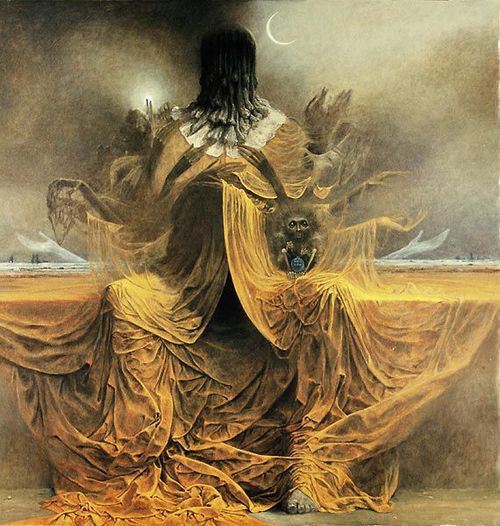
Image much creepier than actual King in Yellow content.

However, once you have your mindset straight, The King in Yellow opens up as a solid read.  It's not bogged down by weighty prose like Lovecraft's tales.  There are no pain-staking descriptions of sagging gambrel roofs.  Though not as lively as, say, William Hope Hodgson, it's quite devourable for Victoriana.

Further, the stories are really fun.  The first-person protagonist in The Repairer of Reputations is BATSHIT INSANE.  I genuinely would love to read a whole novel featuring that guy.  The Mask runs the myth of Pygmalion backwards, with added rabbits.  In the Court of the Dragon capitalizes on everything unnerving about being followed by a stranger through city streets.  The ending to that one is ambiguous and a touch creepy.  The Yellow Sign I described above, and rounds out the 'original collection' (I don't feel like getting into an in-depth discussion of editions here).

If you follow this link to Project Gutenberg, where you can read the whole yummy text, you'll find 6 other pieces that fit the overarching theme of The King in Yellow.  My personal favorites are The Prophet's Paradise and The Demoiselle D'Ys.  D'Ys is your age-old Outlander-type time-travel tale, only it's all about French Falconry!

So what ties such disparate stories together into a collection?  What is The King in Yellow, really?  It's a mythical play- a text that drives all who read it insane!  Excerpts from the play are given at the beginnings of stories, and oftentimes the text will appear to tempt characters into reading it.  Sometimes, as the characters tip over the brink, plunging into madness, they will recount knowledge about "Carcosa where black stars hang in the heavens; where the shadows of men's thoughts lengthen in the afternoon, when the twin suns sink into the lake of Hali; and my mind will bear for ever the memory of the Pallid Mask."  Good stuff.

The King in Yellow, himself, is not explained in the text.  Later additions to the mythos have spun him as an avatar of Hastur.  He is a figure who appears in tattered yellow rags wearing the Pallid Mask.  He is a mad deity to be feared and worshiped for the short time you have left.  Beware the Yellow Sign!

Now, I really enjoyed The King in Yellow.  But this is a horror blog.  Thus, if you're not sold on Chamber's book, I'd like to point you in the direction of the thing I bet you wanted The King to be all along.

May I present to you my all-time favorite: SCP-701 or "The Hanged King's Tragedy."

I like to think that The Hanged King is directly influenced by Salome (an Oscar Wilde play that inspired Chambers, but that's another blog post), and The King itself.  And actual Carolinian plays, of course, which are their own pot o' crazy awesomeness.

The SCP is really well-written, and the cherry on top is that grainy picture.  I had trouble sleeping for two weeks because I kept hallucinating that thing standing in my bedroom doorway.  Hope you have better luck than I did.  But, I guess that's what I get for LOOKING UPON THE PALLID MASK!!

The end.

-Joanna

Monday, January 26, 2015

The Disappearance of Brandon Swanson


In 2008, 19 year old Brandon Swanson was driving home when he crashed his car into a ditch at 2:00AM.  Slightly panicked, on a dark street at night, Brandon called his parents hoping for assistance.  His parents set out to look for him, but to no avail.  They continued a 45 minute phone call with Brandon trying desperately to find him on the wooded streets of Canby, Minnesota.  At one point, Swanson claimed he could see lights and started to head towards the nearby town.  Out of nowhere, his parents heard Brandon exclaim, "Oh shit!" and the call cut off.

This is the last Brandon's parents heard from him.  Now almost seven years later, Brandon still has not come home.  After an intense search with hundreds of volunteers and 34 dogs, Brandon's car was found 120 days after his disappearance, but nothing else was ever found.  Upon finding Brandon's car, there was no evidence of foul play and his family stated that he had no reason to dissapear.  It is widely believed that Brandon slipped and fell into a nearby river but for two days after his disappearance, his phone rang, meaning if Brandon fell into the river, his phone did not fall with him.  It is also odd that the phone records show he was incorrect about his location and was actually 20 minutes away from the town he claimed he could see the lights of.

The tragedy of Brandon's disappearance is felt every day in his parent's home.  They still leave the porch light on for him, though after such a period of time with over 75 tips given to the police department but no strong leads on his whereabouts, his parents were quoted on the 5th anniversary of his disappearance as saying  "It's not that we've forgotten Brandon or anything like that.  It's just that we've searched extensively for 3 to 4 years.  It hurts."

Granted, there is a plethora of missing persons cases filed on a regular basis, none any less sad than the other, but often surrounded by a whirlwind of attention at first and then quickly forgotten when replaced by the next big news story.  It is less often that people stop to think about the families involved in these cases and how when it seems as though everyone else has forgotten about their loved one, they are reminded of them every single day without fail.  What was it that caused Brandon to exclaim "Oh shit!" that night?  Was it as simple as falling into a river (though a body was never recovered from any nearby rivers)?  Was it a criminal taking advantage of the situation?  Was there a supernatural force at play?  Was a wildlife attack possible?  There are endless questions, the answer to which we may never know.

-Amanda

Friday, January 23, 2015

The Host - Movie Review


The Host
Released 2006
Directed by Bong Joon-ho

In the very first scene of The Host, we watch an American mortician order his reluctant Korean assistant to pour 200 bottles of formaldehyde down the drain, into the river.  This scene makes me sad, not because of what it actually is, but for what it seems to have done to people's perceptions about The Host.  This is another brilliant film I put off watching for far too long, mostly because I listened to what other people were saying about it.  Almost everything that mentions The Host name-drops it for its environmental message.  Which is a HUGE DISSERVICE!  Environmentalism probably fifth or sixth down on the list of 'Things This Movie is About'.  Let us list the others:

The Host is about:
Family
American-Korean relations
The Futility of the Individual when struggling against The System
Contagion
Loss
and then we get to Environmentalism...

Environmentalism and monsters go hand in hand. I get it; I understand. I mean, look at Godzilla.  Not just Godzilla the franchise, but Godzilla the institution.  For much of the 20th century filmmakers have used giant monsters to investigate the public's fears about nuclear weapons, pollution, and even genetic manipulation.  Bearing this in mind, it makes sense that The Host is usually name-dropped due to its heavy-handed environmentalist message.  But, to do this is to really miss so much of what makes The Host, truly, one of the best monster movies of all time.

The story is that a mutant monstrosity lopes up the banks of the Han river that runs through Seoul, causing chaos, death, and destruction.  In the midst of popcorn-munching Godzilla-brand crowd-panic, the monster kidnaps Hyun-seo, the daughter of Park Gang-Doo.  Thinking Hyun-seo is dead, the Park family gathers to grieve when they get whisked away to a decontamination hospital.  While going through the boring and confusing bureaucratic process of decon, Gang-doo gets a phone call from Hyun-seo.  She's still alive!  The monster has deposited her in its lair somewhere in the sewers.  So, what is the family going to do?  BREAK OUT AND RESCUE HER, THAT'S WHAT.

Hyun-seo and Gang-Doo, two of our heroes.
From here, The Host is part rollicking adventure, part hilarious satire, and part heartbreaking tragedy.  And I mean heartbreaking.  It has honestly been years since I've seen something that made me cry so hard and genuinely, only to turn around and make me laugh and cheer.  I did not go into this expecting an emotional roller coaster.  But, that's what I got.  This may explain why The Host is the highest grossing South Korean film of all time.  Just sayin'.  And mind you, this is not how I normally interact with movies.  I'm not swayed by emotional pandering- usually because the characters aren't developed enough for me to care.  But not here... not with The Host.

I wish I could tell you how much I love each and every one of the characters in this movie.  Even bit parts are fascinating.  The Host is one of those movies that I hope has a tiny fandom somewhere because I want to join it and look at fan-art cartoons and nerd-out because I ended up loving these people SO. MUCH.  I hope you will too.  Instead of rambling on and on about them, I suggest you just watch the movie- it'll be more elegant and concise anyways.

Need to go back and count the bullets in this movie.
Aside from how emotionally engaging The Host is, it's also a smart movie.  It refuses to satisfy tropes that make no sense.  Like tropes relating to bullets (*sob*).  Or tropes about how pretty, young girls interact with animals (*double-sob*).  Further, The Host knows how to balance on a knife's edge to make its satire very clearly understood without feeling didactic, or distracting from all the other things it's doing with tone and story.

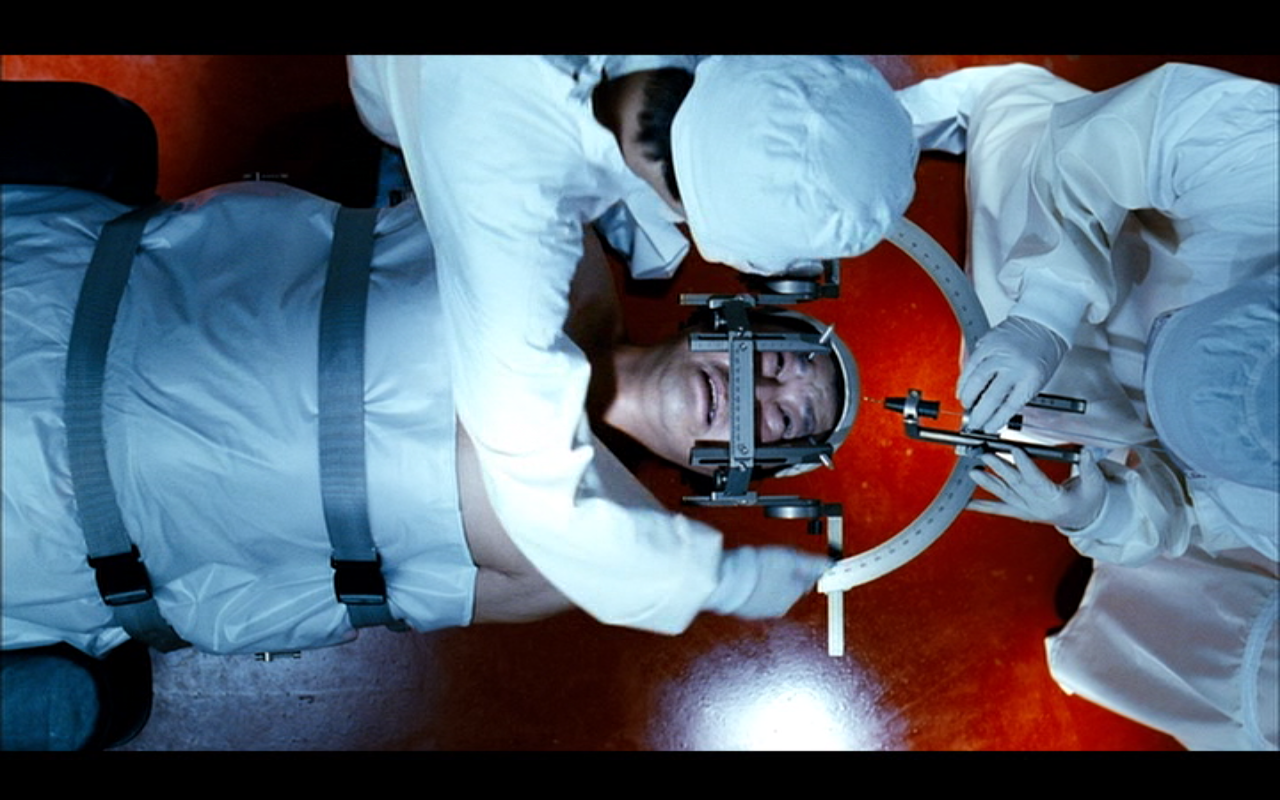
Oh yeah, and let's not forget there are parts of The Host where you remember you're watching a horror movie.  Notably, the section of the film where American military scientists capture Gang-Doo and attempt to lobotomize him.  He calmly tries to bargain with the doctors in a scene so quietly dreadful it makes the ending of One Flew Over the Cuckoo's Nest look justified in comparison.  Or maybe that's just because I like Gang-Doo at lot more than I do McMurphy.

"No guys, really, this is all a misunderstanding.  I gotta find my daughter."
This is usually the part of the review where I try to warn you so your expectations will not betray you, but to me this is difficult.  There's nothing I dislike about this movie.  The CG holds up beautifully, the pacing is spot on, the themes are up my alley.  Even that opening scene that caused so many to file The Host under "Enviromentalist Propaganda" and forget about it.  In context, the opening is actually very funny.  It's more about how laughably ridiculous and dumb American arrogance is than how formaldehyde makes a monster.

To stretch, I'm sure there are things others wouldn't like about this movie, but they're really a matter of taste.  Perhaps you won't like the characters like I do.  They reminded me a lot of the Bluths from Arrested Development, and I know that plenty of people find the Bluths "unlikeable".  The Park family is kind of like that.  Dysfunctional, but still loyal to one another.  Deeply flawed, but trying to be noble.  But also mean, or stupid, or cold, or drunk at times.

You might also dislike how The Host plays three games at once: Action-Thriller, Comedy, Tragedy.  It swirls between them quickly in a way I find delectable.  But this also means that the movie inserts humor in its darkest moments, and insecurity into scenes where you want the heroes to be invincible.  I love this so much, but I know others may think it scatterbrained or inappropriate (but I snub those opinions, anyway- snub, snub).

But if you like your monster movies to be great films too, I highly recommend The Host.  Or if you like your action movies to be wish-fulfilling and epic, I highly recommend The Host.  Or if you like your family dramas full of broken, realistic people, I highly recommend The Host.  You get the point...

-Joanna

Wednesday, January 21, 2015

'The Writer' Automaton


In the 1770s, the little creeper shown in this video, The Writer, was created by Swiss clockmaker Pierre Jaquet-Droz.  When wound up, the 6,000 tiny parts and cams within the little boy work in tandem to move his quill into the pot of ink and back to his paper to write a sentence of up to 40 characters.  The Writer is so significant because at the time, the ability to change and program the message that the boy writes was quite groundbreaking and even lauded as "the first computer."  Jaquet-Droz is also the creator of The Draughtsman and The Musician, pictured below.


While it can be agreed that these creations are very interesting and innovative, it also cannot be argued that these little creatures are creepy!  And in the video, WHY would BBC lay over such creepy music as it scans over The Writer's soulless little eyes rolling around in its head?  Perched at his table in a pitch black room, he casually writes a message about how he will eradicate all of humanity.


A couple of interesting side notes: The Musician "breathes" - movements of her chest can be seen as she plays, also balancing her torso as a real musician would.  Additionally, The Draughtsman (arguable The Writer's inferior little brother with only 2,000 parts) can draw four different pictures including a portrait of Louis XV and is sporting a lovely chipped manicure.  


The Writer inspired the design of the automaton in the 2011 film, Hugo, directed by Martin Scorsese.  All three automatons are still functional today and can be seen in the Musee d'Art et d'Histoire in Switzerland.

-Amanda


Monday, January 19, 2015

The Moon-Eyed People

A request was made, once upon a time, that we include articles about lore, folk tales, and the extra disturbing ghost stories that our grandparents swore were true.  So, here we go with our first Matter-of-Fact Monday devoted to anthropology (of a sort)!


In the Appalachian mountains that range from Kentucky down to Georgia, there are strange formations in the rock.  Fortresses have been carved into the pre-existing features of the stone, and rocky walls dating back to 400 B.C. snake their way through the trees.  When Europeans began to sweep across the hills, they marveled at the ruins.  They asked the local Cherokee: Who built these structures?  The answer was not "We did." but rather "The Azgen.  The Moon-Eyed People."

The story goes that long ago, when the Cherokee first traveled to Southern Appalachia, they met a race already living among the mountains.  Their skin was the purest white, and their hair yellow.  They had beards, and large eyes that allowed them see well at night, but blinded them during the day.  They were so sensitive that they were even hurt by the glow of the full moon.  In some places, the story says it was the Creek that murdered the Moon-Eyed People, in others, the Cherokee themselves claim to have wiped them out.  The lone survivors were driven underground to live in subterranean tunnels, far from light and war.  The ghosts of the murdered still haunt the hills to this day.

In Ohio, the Shawnee refused to settle in Kentucky.  Despite it being prime hunting grounds, they claimed that if they set up their permanent dwellings there, they would be killed by the ghosts of the dead Azgen.

In Georgia, just over the North Carolina border, the Fort Mountain State Park preserves one of the most impressive ruins attributed to the Moon-Eyed People.  Massive stone fortifications towering several stories high have stood for thousands of years.  A historical marker is even dedicated to the 'legend' of the Moon-Eyed People.

It is said that on the darkest nights of the new moon, the Moon-Eyed People still venture out to steal livestock, property, or women and children.

There are several theories as to what may have inspired these tales.

1) The Welsh:

In 1810, John Sevier, former governor of Tennessee, wrote that he'd been told by the Cherokee leader Oconostota that the Moon-Eyed People were, in fact, Welsh.  There was a popular theory that noted how well the stories about the Moon-Eyed People lined up with the legend of Prince Madoc.  Madoc was said to have sailed across the ocean long before Columbus, and may well have settled in the New World with a band of his countrymen.  This would explain the pale skin and yellow beards.

Though this seems to be the most popular theory about the Moon-Eyed people on the internet, there is also the criticism that this account is more a testament to white colonial influence than historical fact.  Aside from these testimonials, and wild conjecture, there is no evidence that the Welsh traveled to North Carolina and became The Moon-Eyed People.


2) Albinos:

The Guna, an indigenous people of Panama, exhibit extremely high rates of albinism.  More common in males, albinos are treated as a different race and traditionally honored with a crucial task: protect the moon.  At night, they are sent out with special bows and arrows to shoot at the dragon that attempts to swallow the moon during lunar eclipses.  This keeps the moon safe and keeps the tides in check, a particularly important concern for people who live on an atoll.

It is not assumed that the Moon-Eyed People are a branch of the Guna.  But rather, the Guna are an excellent example of how an indigenous race could be a natural explanation for the Moon-Eyed People.  Through intertribal marriages, it is possible that a race of pale, yellow-haired people could have emerged organically, without an infusion of European genetics.


3) The Lost Tribes: 

After the Assyrian conquest of the northern kingdom of Israel in 721 B.C., ten of the twelve tribes of Israel disappeared.  It is commonly assumed that they were assimilated into the surrounding nations.  However, there has long been the hope that the ten tribes would one day be rediscovered, and reunited.  A theory common among Mormons is that the Native Americans are, in fact, one of the lost tribes of Israel.

In this theory, the Moon-Eyed People are jews, instead of welshmen or indigenous albinos.

I personally ascribe to the albino theory.  The other two simply don't sit well with the accounts of the Azgen, or common sense.

If you'd like to read more about the Azgen, including multiple citations of primary sources, take a look at this snarky, in-depth article by a real anthropologist: The Moon in Your Eyes.

-Joanna

P.S. Hope you don't run into any Moon-People if you visit home, Laura.  Enlist a war-possum if you get in deep.