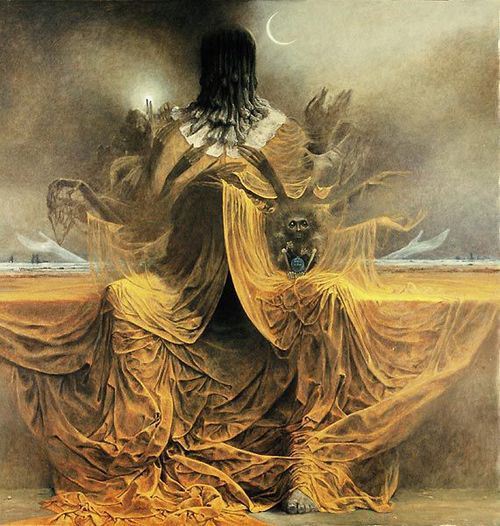
Showing posts with label insanity. Show all posts
Friday, August 21, 2015
They Live - Movie Review
They Live
1988
Written and Directed by John Carpenter
Surely, living in this internet age, you've heard the classic line: "I have come here to kick ass and chew bubblegum... and I'm all out of bubblegum." A line so goofy and loveable it's been recycled and reworked for years; to the point that its origins are beginning to fade into the mists of time. Well, lemme remind you: that line was penned by John Carpenter, and delivered by a shades-wearing, denim-clad Roddy Piper just prior to shooting up a bank with a shotgun. In the movie They Live, not real life, of course.
Except.... there are many, many people who find the premise and delivery of They Live so compelling that they kinda believe it's true. Or at the very least reference it as a pop-culture interpretation of (what they believe to be) the TRUTH. Whether it's Reptilians or the Illuminati, They Live hits all the right buttons for individuals who believe the world is ruled by a shady, secret organization intent on keeping the masses sedate and obedient.
Why is this so? Well, I've got a theory!
Not only do I have a good theory for why They Live is so compelling to conspiracists, but my theory also makes sense of how John Carpenter could create such an odd movie. How on earth was this made by the same individual that gave us two of the finest horror movies of all time: The Thing and Halloween? Don't worry, all knowledge will be revealed in time.
To catch you up, in case you haven't had the distinct pleasure of viewing They Live: it's the story of a drifter who stumbles onto the TRUTH of how the world is being run by an alien race intent on the permanent dominion of humanity. These gross aliens are in charge of every level of government, the media, the military, and even circulate in society as wealthy and affluent citizens. They hide in plain sight because they have a transmitter which reprograms humanity's brains to keep humans deluded into mindless obedience and a life-style of thoughtless consumption. Our protagonist discovers this when he puts on a special pair of sunglasses that allows him to see life as it REALLY IS.
Our hero then proceeds to go on a shooting rampage, runs from the law, joins a resistance movement, and ultimately blows up a news station that is also a hub for the alien brain-wave transmitter. There are lots of explosions, my favorite fist-fight in all of film, and Roddy Piper delivering some of the most insane and wonderous lines in cinema, making this a super-fun cult movie if nothing else.
The movie as a whole is an odd-duck. Its script is very sparse. Carpenter spends large amounts of time filming Piper wandering around and looking at things. And while this sounds boring, it isn't really. The movie is shot competently, and despite its lack of conventional dialogue, conveys information effectively (allowing the audience to be drawn in to the mystery along with the protagonist). But when the script does come into play, often the lines are incredibly strange, almost surreal.
And mind you, this is not to be blamed on Piper's acting ability. This strangeness is spread across the whole script. From the utterly suburban and mundane lines uttered in the background by aliens, to the ranting of a blind priest, it seems to me that Carpenter was working hard at making the whole movie kind of uncanny. This is how you get things like the bubble-gum line.
Apart from the script, the movie oscillates between a slow-burn anticipation/reveal of mysteries, and all-out popcorn-munching action. The scenes where Piper is coping with the TRUTH, a greyscale world where billboards shout CONSUME and all signage is bent on subconsciously reprogramming humans, are particularly heavy-handed. But then Carpenter will treat us to high-paced scenes where Piper runs from the alien cops, then carjacks and kidnaps a woman at gunpoint.
Altogether, this makes They Live seem like a misfire. A movie that wants to be ambitious in saying something about society (or whatever), but also wants to be a mindless shoot-em-up flick. This mismatching in tone, the weird script, the looniness of the content, all contribute to this being seen as a 'bad' movie. Mind you, a bad movie to be enjoyed for all its badness; to revel in its 'cult' status. But certainly not something to be brought up in serious conversation. In this way I think it shares a lot in common with Carpenter's other movies like Big Trouble in Little China or John Carpenter's Vampires starring James Woods. Movies so hokey they can't help but be loved.
To be honest, this is how I considered They Live for a long time. It's incredibly fun to laugh at the ridiculousness of this movie, and move on to more respectable fare.
However, I got a theory. And like Piper putting on the sunglasses for the first time, it's CHANGED EVERYTHING FOR ME.
I have a hard time believing that John Carpenter just entirely forgot how to make a good movie in the six years between making The Thing and They Live. Even if we count the other four movies he made in the interim (Christine, Starman, Big Trouble in Little China, and Prince of Darkness) to be complete floppy failures (which they are not, merely different beasts to be judged on their own merits), it's still hard for me to say that They Live is the same kind of thing. Big Trouble is clearly not meant to be taken seriously. They Live is not so clear. But if you try to take it seriously, it's far too wacky by the end to cope with. How do I cope?
Then it hit me: They Live is not a movie about an alien conspiracy. They Live is a depiction of a deeply disturbed individual's paranoid fever dream. That the character Roddy Piper plays is in fact mentally ill, and that the whole movie is a wish-fulfilling fantasy for a deranged mind. If you take the movie in this context, a lot of things about it start making a lot of sense.
For example, how is the audience supposed to believe that a man can walk into a bank, deliver the bubble-gum line straight-faced, shoot multiple people in the chest, and then run away into an alley with ZERO CONSEQUENCES? Because it's not actually happening. It's just one vignette in a paranoid schizophrenic's power-fantasy*. That's why the line is so bad, but is so delicious to say. That's why there's no consequences.
If you watch They Live from this perspective, the perspective of a mad drifter overlaid on reality, the movie suddenly becomes chilling. All the "aliens" he murders are just normal people, his erratic behavior makes a lot more sense, his cryptic speech patterns fit. He fantasizes about being powerful, being in-the-know, fighting a massive conspiracy for the good of mankind, becoming the ultimate hero.
If They Live is a delusion in the protagonist's head this explains the abominable writing that afflicts the other characters in the movie, such as the woman that he kidnaps. This same woman who throws him out a third-story window, the same woman who inexplicably becomes his love-interest by the end of the movie. Of course he projects imagined relationships onto the people around him, based on even the most minor or toxic contact. Of course he wins his friend over to his side immediately and completely after a fist-fight and one glance through the 'magic sunglasses'. Because none of this is actually happening. Or, at least it isn't happening in the way it's presented.
I think that looking at the movie this way makes sense of a lots of its perceived weaknesses. The action is schlocky because the protagonist has poor taste, and his delusion follows suit. The pace and script are uneven and weird because his perception is warped by his slow descent towards a complete break with reality. The way the world looks through the glasses is informed by the pulp alien movies of the drifter's childhood from the 1950s and 60s, even unto the Ed Wood-sy flying saucers and vacuum tubes. Characters from the drifter camp in the beginning of the movie recur in unbelievably unlikely spaces (a bum ends up wearing a tuxedo and showing them around at an Illuminati party).
If my theory is true, this means two things.
One, that this movie instantly becomes more interesting. It becomes downright creepy, in fact, because it tethers the wackiness of the film down into the real world, down to that guy raving incoherencies on the street-corner. It also provides plenty of entertainment for those who want to unravel what is happening in reality in the movie, and what is delusion.
Two, it explains the movie's popularity in conspiracy-circles. Not that everyone in conspiracy circles is mad and dangerous, but rather it shows that Carpenter got something very right. That something about They Live taps into the drives of people who are attracted to conspiracies in a way that's greater than just the p's and q's of its content. There are no magic sunglasses, but there are lots of people who believe they can see THE TRUTH.
And, when you think about the more violent scenes in They Live under the context of recent mass shootings, it suddenly becomes a very plausible and very frightening movie indeed.
-Joanna
*Note: I understand that not all paranoid schzophrenics, or the mentally ill at large, are violent or have fantasies of this sort. They need love and I hope the reader will not take this theory as someone casting yet more shade upon an already stigmatized group as a whole.
Monday, May 18, 2015
The Tanganyika Laughter Epidemic of 1962
![]() |
| Still from Laughology (2009). |
However, with the exception of Radiolab, the epidemic is usually treated as an amusing oddity, or even a positive, if silly, experience. "Isn't laughter great!? Can you imagine whole villages laughing for months? Crazy, huh? How fun!" I bet you can see where this is headed...
Here at HoJ Horror, we strive to view things through a creepier lens, peeling back the fluffy exterior of the world and staring at its more gruesome contents. By the time we get to the end, I hope you'll be able to see how the Tanganyika Laughter Epidemic is terrifying in two ways. Spooky in itself, and also spooky for what it means.
Let's start with the facts: On January 30, 1962, three girls started laughing in a mission-run boarding school in the village of Kashasha. On the western shore of Lake Victoria, near Uganda, the laughter spread through the school, afflicting another 95 students. While the teaching staff remained immune, the girls between the ages of 12 and 18 would laugh and cry uncontrollably for hours. The 64 children unaffected by the laughing were unable to concentrate during classes, and on March 18th of that year, the school was closed down entirely.
Once the school closed, the girls were sent home, and the laughter spread. In the village of Nshamba, 217 children and young adults came down with the laughter in April and May. In June, the laughing hit another girls' school in Ramashenye.
As the condition spread, it soon began to infect adults of all ages, men and women. Entire villages would suffer from the hysterical condition for days on end. Sometimes the laughing would ebb away, only to return days later. This continued for 18 months throughout the north-west corner of Tanganyika until the middle of 1963. It is said to have affected up to 1000 people.
It is important to note that the symptoms of the laughing sickness were not limited to giggling. Pain, fainting, respiratory problems, attacks of ceaseless crying, and random screaming were all a part of the 'laughing'.
Here is an excerpt from Laughology, the aforementioned documentary. Despite its attempt at light-heartedness, it comes off as a nightmare.
But why did these people laugh, cry, and scream for hours upon hours, stretching into days? The first approach is to compare it to other instances of 'mass hysteria'. Most of these episodes strike young women between the ages of 15 and 20. Consider the Salem Witch Trials or, more appropriately, the "Strawberries with Sugar Virus" of 2006. Indeed, the Tanganyika Laughter Epidemic did start with adolescent girls, but it eventually spread to include adult men. Besides, it's super-condescending to chalk this up to "teen girls are just hysterical."
Another point to be made is that this episode differs from other incidents of madness that can be attributed to environmental factors. I've got some articles in the works examining the effects of Ergotism and Kuru, but the epidemics associated with these maladies are clearly traceable to biological factors. The Tanganyika Laughter Epidemic, on the other hand, shows no evidence of toxic exposure or disease. As Christian F. Hempelmann noted in this article for the Chicago Tribune, the Epidemic qualifies as a legit Mass Psychogenic Illness (MPI). Meaning, it was an affliction caused entirely by the minds of its victims.
However, we're still faced with the question of why? Well, to draw on some conclusions Hempelmann has made, it was likely connected to the immense changes that Tanganyika was going through at the time.
Tanganyika declared its independence from the British on December 9th, 1961, only weeks before the epidemic began. As the nation transitioned, the people were subject to incredible social upheaval. When the government switched to Socialism, it not only rearranged the economy, but also outlawed many of the local tribal religions (supplanted by Christianity). Faced with such sweeping changes, the rural villagers of Tanganyika were under significant stress.
To quote Hempelmann: "There is an underlying shared stress factor in the population. It usually occurs in a group of people who don't have a lot of power. MPI is a last resort for people of a low status. It's an easy way for them to express that something is wrong.
In other words, the people caught up in the Epidemic couldn't find any other way to release their anguish. When they failed to cope, they were left with nothing but humorless, hysterical laughter that exhausted their bodies. Laughter that took turns with inconsolable crying and screaming.
Words failed them, so they laughed.
-Joanna
For more content about the Tanganyika Laughter Epidemic, and a great theory about caterpillar ghosts, check out this episode of Radiolab: http://www.radiolab.org/story/91595-contagious-laughter/
Friday, February 27, 2015
Oculus - Movie Review
Oculus
2013
Directed by Mike Flanagan
Spoiler Free!
Whoa, wait, what? A deeply-moving examination of childhood abuse and trauma masquerading as a half-wit Death Bed remake? Not what I expected.
Oculus is a feature-length adaptation of a award-winning short released in 2005. Sadly, I haven't seen the short, so cannot compare it in this review, but suffice to say it was compelling enough that studios tried for years to pick it up as a "found-footage" picture. Flanagan refused these attempts, and finally agreed to make Oculus on the express condition that it NOT be found-footage. During the scripting process, they expanded the original premise of the short by intertwining storylines of the past with the present.
But this isn't just a mish-mash of flashbacks. Oculus tells the tale of a supernatural, EVIL mirror that has the power to warp reality around it. It kills houseplants, absorbs dogs, and causes intensely realistic hallucinations, driving its human victims to their deaths! As the movie unwinds, the boundaries between memory and illusion become increasingly blurred until they rip apart altogether.
The story goes that a brother and sister have finally returned to their childhood home: a house of horrors where both their parents died. Tim has recently been released from a mental institution. Kaylie has made her way past the trauma on her own, landing a job as an antiques dealer. Kaylie convinces Tim back to the house because she's located the EVIL mirror that she blames for her parents' descent into insanity and their deaths. Kaylie intends to document the mirror's powers, and then destroy it.
Tim is skeptical, until strange things begin to happen. And as we are led down the twisting path of the last innocent days of Kaylie and Tim's childhood, we begin to see why Tim needed to be in an institution, and why Kaylie is so very... intense.
Of course there are ghosts. Booooooo. But I'll explain why this is a boo in a bit.
![]() |
| Full disclosure. |
Further, as an individual who suffers frequently from severe nightmares, hallucinations, and hideous intrusive thoughts, it was really awesome to have a movie I could point at and exclaim "Look! See when she bites that lightbulb! It's not real, but it might as well be. That's what it's like! That's why X bothers me so much..."
Anyways, I really liked and identified with Kaylie. She's a great character because her intelligence, resourcefulness, and determination are not undercut by her mental frailty. Rather, her unbalanced mind renders her complex and flawed in a way that is empathy-inducing. A way that would only make her look foolish to the most callous and under-developed adolescent.
Tim is the same way. His skepticism is level-headed yet born out of a deep sense of self-preservation. As such, Oculus accomplishes something to be pleased about: characters that are flawed and fearful for a good reason, not some loaded-in stupidity that's requisite for the genre tropes and cliches to go off. Their childhood was deeply traumatic, and that's bound to make people messed up. Thus, by actually giving us characters instead of cardboard dolls, the audience is able to empathize and relate to them. Then, the trouble they get into is believable. And then, Boom: Horror that works. Crazy, huh?
![]() |
| Watch out: we're about to dive deep. |
This gets us to the heart of Oculus: how to cope with trauma. Frequently in the beginning of the movie, Tim admonishes Kaylie for believing that the mirror is EVIL. He claims that this is just an elaborate delusion she's constructed to cope with the inconceivable horrors of their past. Memories are unreliable and fluid, and mysteries muddied by time can be easily explained. The dog had Parvo, dad was just having an affair, etc. etc.
We see how stubborn Kaylie is in response. How doggedly she chases an explanation that will make her mom and dad and brother Good People, people who were Not Responsible. She's nestled deep into her obsessive insanity because believing in an EVIL MIRROR is easier and better than believing in the mental illness and abusiveness of her parents. It's easier than facing the fact that her brother became a killer at 10 years old.
These threads: the unreliability of memory and the rationalizations we weave to cope with the unspeakable, are then mixed into an even nastier snarl with PTSD-type flashbacks and triggerings. Time may have allowed Kaylie the ability to function in the world, but as the movie goes on, a very true thing becomes patently clear: somewhere on the inside there is still a terrified, frustrated, overwhelmed young girl. There's a part of Kaylie that will always be that girl, fighting not to be afraid of the people she ought to trust most. The mirror merely brings that piece to the surface. And then when we consider how identity over time is not so linear and solid as we like to believe, and how our conceptions about our memories shape who we are, and you get quite the tangled web.
Speaking of tangled webs, Oculus accomplishes a somewhat impressive feat by keeping its shit straight. I'm sure there are plenty of loopholes and details that people might point out as being flaws (while missing the point that flaws in recollection are exactly what the movie is ABOUT), but all things considered, this movie does an amazing job of minding its p's and q's. Transitioning cleanly between the present, the actual past, hallucinations in the present, memories, and hallucinations designed to look like memories, Flanagan and his team pulled off a plot-line circuitous enough to make Christopher Nolan proud.
![]() |
| My gum disease is sooooooo spooooooopy! Be Spooped! |
On to the Bad Parts: those useless spoopy ghosts.
Sadly, though, because it works so hard to make the EVIL MIRROR real, and the SPOOPY GHOSTS real, it completely undermines what is truly horrifying and resonant about the film. What is more disturbing than not being able to trust your own mind? Ladies with cataracts and bad teeth? I mean, if we have a movie with two deeply scarred young people, returning to the location where all their horrors happen, it's bound to trigger all sorts of things inside them, resulting in a mind-breaking descent into madness. To insist on the device of a haunted mirror is tiresome and juvenile.
And... I'm not even going to go into how predictable and useless the ending is. Ugh.
However, I don't particularly blame the film-makers for this as much as I blame the market. A lot of horror is unbelievably terrible these days because it's what sells. Honestly, I'm impressed that Oculus even got made, and was popular enough to get, what, two sequels picked up? So, I understand why they shoe-horned stupid ghosts in, I just whole-heartedly believe it would have been a magnificent movie without them. The kind of movie that could be like a little baby sister to The Shining.
Speaking of The Shining, though, I'd also like to point out that the way Oculus is made leaves a little to be desired. While the film-making was clean and the editing very polished (as stated above), I would have liked a bit more in the way of directorial and aesthetic flair. The movie is very competently shot, and a portion of me wants to argue that any more visual stylization would distract from the plot, but... there's a but. Atmosphere is frequently built via literal darkness more than shot-framing, and the palette of color and texture could have been more vivid for my tastes (this is a movie about insanity, afterall- we can use shades other than white, bright red, dusty ochre, and black). As a result, I often felt like Oculus was an extremely well-planned film shot by someone fresh out of school, who hasn't yet had a chance to develop their personal visual style. I would love to see this redone, sans the conceit of the mirror being actually EVIL, and with a bit more verve. I think what I want is The Shining.
In short, Oculus definitely has its problems. It's not a movie that knocks it out of the park. But, it's got a lot of good stuff hidden away inside its shell. In other words, Oculus understands the jungle it's in, and has spent a lot of time camouflaging itself as a SuperSpoopyGhostMovie, so that it can continue to feed and lay its eggs in peace. This makes me happy in a strange way. Instead of disappointment, I see something hopeful. That there are people out there capable of making good, compelling, useful horror, even if they have to frost it with dumbness for now.
-Joanna
Wednesday, January 28, 2015
The King in Yellow - Book Review
The King in Yellow
by Robert W. Chambers
written 1895
If you're into anything Cthulhu-related you've probably heard about The King in Yellow. Though Lovecraft did not create The King in Yellow, the King has since been thoroughly folded into the Cthulhu mythos, taking his place in the eldritch pantheon alongside Nyarlathotep and Azathoth. Having read through all of Lovecraft, I decided it was time I finally found out what the King in Yellow is all about.
Turns out, it's a pretty good read, if not a particularly scary one.
Let's start with a bit of background. Robert W. Chambers spent most of his career writing topical, popular fiction for the masses. Shopgirl romances, upper-crust scandals, thrillers, historical epics written for easy-reading and money-making, it seems Chambers was quite the James Patterson of the late Victorian era. This context, then, makes The King in Yellow even more unusual. The 4 main stories of the work are strange and soaked in madness. Later entries involve time-travel and a cycle of poetry. Overall, for its time and considering Chambers' previous works, The King in Yellow is far-out.
![]() |
| I want a Pallid Mask. |
Sadly, though, I don't think today's audiences would think it so. Perhaps because in the past century our weird fiction has gotten extremely weird, The King is most enjoyable as a Victorian artifact. Many of the stories have plots that modern audiences would feel like they've heard a thousand times by now. For example, The Yellow Sign (possibly the most well-known story from the collection) is about a woman haunted by dreams of her impending death, and a man followed around by... wait for it... a zombie. Just one zombie. And it doesn't eat him, it just punches him in the face then kinda turns to dust at the end. The reveal of the man with the face of a "plump, white, grave worm" being dead all along was probably super creepy in 1895. Nowadays... it's not quite the stuff of nightmares.
But I only talk about this to explain why so many reviews of The King in Yellow say it "isn't scary", is "boring" or "cliche", and "doesn't hold up well". Of course it doesn't hold up well! If Shakespeare was written in language closer to our modern tongue so that it lacked the exoticism of iambic pentameter and Early Modern English, we'd have people complaining all over Goodreads about how it's "so unoriginal" too! You know, because appreciating something for being original in its time is hard and involves thinky-thoughts.
The rub is that when I read Lovecraft, I did get spooked. The Dunwich Horror and The Colour Out of Space in particular kept me up at night. Upon learning that Lovecraft was influenced by The King in Yellow and included bits from it in his mythos, I went in expecting to be creeped out. In all honesty, it took me a few stories to readjust my settings to be able to enjoy Chambers' book.
| Image much creepier than actual King in Yellow content. |
However, once you have your mindset straight, The King in Yellow opens up as a solid read. It's not bogged down by weighty prose like Lovecraft's tales. There are no pain-staking descriptions of sagging gambrel roofs. Though not as lively as, say, William Hope Hodgson, it's quite devourable for Victoriana.
Further, the stories are really fun. The first-person protagonist in The Repairer of Reputations is BATSHIT INSANE. I genuinely would love to read a whole novel featuring that guy. The Mask runs the myth of Pygmalion backwards, with added rabbits. In the Court of the Dragon capitalizes on everything unnerving about being followed by a stranger through city streets. The ending to that one is ambiguous and a touch creepy. The Yellow Sign I described above, and rounds out the 'original collection' (I don't feel like getting into an in-depth discussion of editions here).
If you follow this link to Project Gutenberg, where you can read the whole yummy text, you'll find 6 other pieces that fit the overarching theme of The King in Yellow. My personal favorites are The Prophet's Paradise and The Demoiselle D'Ys. D'Ys is your age-old Outlander-type time-travel tale, only it's all about French Falconry!
So what ties such disparate stories together into a collection? What is The King in Yellow, really? It's a mythical play- a text that drives all who read it insane! Excerpts from the play are given at the beginnings of stories, and oftentimes the text will appear to tempt characters into reading it. Sometimes, as the characters tip over the brink, plunging into madness, they will recount knowledge about "Carcosa where black stars hang in the heavens; where the shadows of men's thoughts lengthen in the afternoon, when the twin suns sink into the lake of Hali; and my mind will bear for ever the memory of the Pallid Mask." Good stuff.
The King in Yellow, himself, is not explained in the text. Later additions to the mythos have spun him as an avatar of Hastur. He is a figure who appears in tattered yellow rags wearing the Pallid Mask. He is a mad deity to be feared and worshiped for the short time you have left. Beware the Yellow Sign!
Now, I really enjoyed The King in Yellow. But this is a horror blog. Thus, if you're not sold on Chamber's book, I'd like to point you in the direction of the thing I bet you wanted The King to be all along.
May I present to you my all-time favorite: SCP-701 or "The Hanged King's Tragedy."
I like to think that The Hanged King is directly influenced by Salome (an Oscar Wilde play that inspired Chambers, but that's another blog post), and The King itself. And actual Carolinian plays, of course, which are their own pot o' crazy awesomeness.
The SCP is really well-written, and the cherry on top is that grainy picture. I had trouble sleeping for two weeks because I kept hallucinating that thing standing in my bedroom doorway. Hope you have better luck than I did. But, I guess that's what I get for LOOKING UPON THE PALLID MASK!!
The end.
-Joanna
Subscribe to:
Posts (Atom)